A lot of renewable developers are asking the wrong question right now.
“How fast can we grow the pipeline?”
Given today’s market dynamics, the better question is:
“How executable is the pipeline we already have?”
Interconnection queues remain volatile.
Merchant exposure is under scrutiny.
Capital is more selective.
So the smartest move for IPPs right now isn’t breadth.
It’s execution density.
From a GTM and development lens, here’s a simple framework teams can apply immediately:
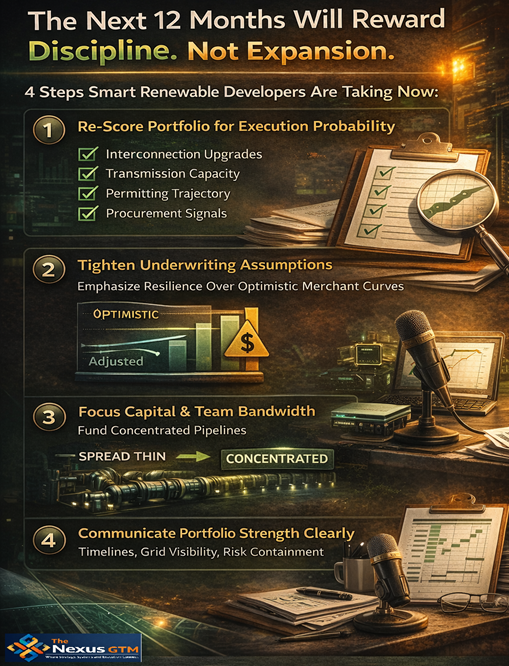
1. Re-score your portfolio for execution probability
Not just resource quality or land control.
Include:
→ Interconnection upgrade exposure
→ Transmission capacity visibility
→ Permitting trajectory
→ Utility procurement signals
2. Tighten underwriting assumptions
Projects that only work under optimistic merchant curves
will struggle in investment committees.
Build resilience into the model.
3. Focus capital and team bandwidth
Spread pipelines create drag.
Concentrated pipelines move faster through financing, permitting, and procurement.
4. Communicate portfolio strength clearly
Investors and partners are prioritizing clarity:
→ Execution timelines
→ Grid visibility
→ Risk containment
Developers who articulate this well unlock capital faster.
In the next cycle, the winners won’t be the teams with the most projects.
They’ll be the teams with the most executable projects.
If you want,
we can run a precision portfolio strategy session
and outline a practical 90-day execution plan.