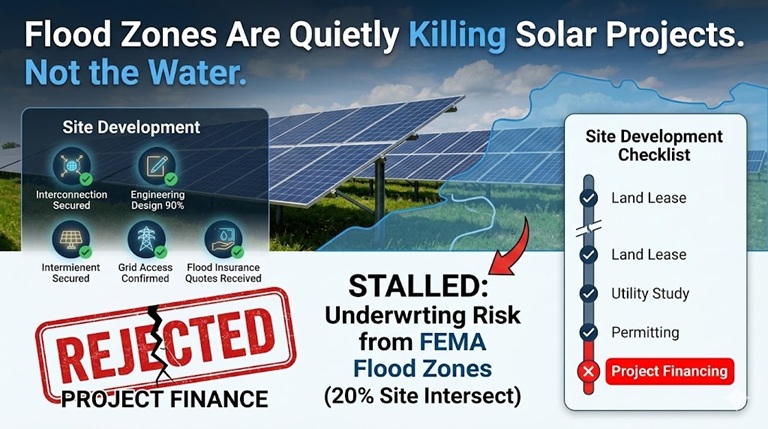
A solar + BESS developer came to me frustrated.
The site penciled beautifully.
Strong irradiance.
Grid access secured.
Interconnection progressing.
Yet the project stalled before financing.
Why?
Flood risk.
Not actual flooding.
Perceived risk.
This is a pattern I see across utility-scale development.
Sites look viable technically.
But die in underwriting.
Industry benchmarks tell the story:
→ ~15–20% of U.S. solar sites intersect FEMA flood zones
→ Insurance premiums can swing project IRR by 100–300 bps
→ Lenders increasingly require flood mitigation narratives before closing
Most developers treat this as an engineering problem.
It’s actually a GTM problem.
The issue wasn’t the flood zone.
It was how the risk was positioned.
The developer had:
Engineering reports.
Drainage models.
Elevation studies.
But none of it translated to investor confidence.
So we reframed the narrative.
Instead of defending the site, we packaged the mitigation.
→ Elevated racking strategy
→ Flood-resilient inverter placement
→ Hydrology-backed site design
→ Insurance-ready risk documentation
Same site.
Different story.
The result?
Financing moved forward.
Risk committee objections dropped.
The project advanced.
Here’s the contrarian truth in solar development:
Developers don’t lose projects on engineering.
They lose them on risk storytelling.
From a GTM operator lens, the best developers don’t just build projects.
They de-risk the narrative for capital.
Because in this industry, projects don’t move at the speed of sunshine.
They move at the speed of investor confidence.
If you’re developing solar or BESS projects in flood-sensitive regions and seeing deals stall,
comment “FLOOD” and I’ll share the mitigation framework developers use to keep projects financeable.